
This content is provided for informational purposes and does not constitute financial or investment advice. Consult a qualified financial adviser, notary, or property lawyer for any property investment decision.
The Courchevel property decision splits international buyers into two camps: those drawn to individual chalet ownership with its architectural autonomy and alpine authenticity, and pragmatists who recognize apartment ownership delivers turnkey access without management burden. The gap between these two property types extends far beyond purchase price—annual running costs, rental yield mechanics, and overseas management complexity create fundamentally different investment profiles that most buyers fail to model accurately before commitment.
Market data from Courchevel's current listings reveals the financial chasm: chalets in Courchevel 1850 command 31,083 € per square metre while apartments in Courchevel Moriond start at 13,695 € per square metre—a 127% premium for freehold chalet ownership. This price differential represents only the visible cost. Hidden beneath lie annual expenses ranging from €30,000 to €50,000 for large chalets versus €8,000 to €15,000 for managed apartments, alongside divergent rental yield realities and resale liquidity profiles that transform the ownership experience over five to ten years.
Your Courchevel property decision in 60 seconds
- Chalets in Courchevel 1850 cost €31,083/m² versus €13,695/m² for flats in Moriond—a 127% premium for individual ownership
- Annual running costs diverge dramatically: chalets €30,000-50,000 versus flats €8,000-15,000 for heating, management, and maintenance
- The decision hinges on three factors: budget ceiling, weeks of annual use, and capacity for active management involvement
- Realistic net rental yields settle at 4-6% after deducting 15-25% management fees and accounting for vacancy periods
- French notary fees add 7-8% to the purchase price; IFI wealth tax applies above €1.3 million for non-residents
This guide provides a structured framework for international buyers navigating Courchevel's dual-track property market. The analysis examines purchase price differentials, ongoing cost structures, rental yield mechanics, and village-specific factors that determine whether chalet or apartment ownership aligns with buyer objectives and constraints.
Each property type presents distinct advantages and limitations across financial, operational, and lifestyle dimensions. The decision requires matching measurable buyer circumstances—capital availability, annual usage patterns, and management capacity—to property characteristics that cannot be altered after purchase.
Courchevel's property split: understanding the luxury landscape
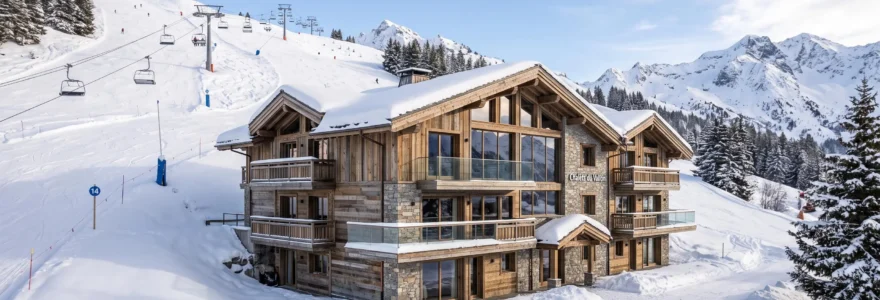
Courchevel's luxury real estate market operates on a dual-track system that separates the resort into two distinct ownership experiences. The first track comprises individual chalets—freehold properties ranging from intimate four-bedroom mountain retreats to sprawling ten-bedroom estates with dedicated staff quarters. The second encompasses apartment ownership within managed buildings, where co-ownership structures (copropriété under French law) distribute maintenance responsibilities across multiple owners while centralizing concierge and facility management.
Current market inventory from established agencies reveals the scarcity dynamic: three apartments listed for every single chalet, reflecting both construction constraints in Courchevel's protected mountain environment and the development economics favoring multi-unit buildings over individual plots. This 3:1 ratio shifts dramatically across Courchevel's five villages—Courchevel 1850, Courchevel Village, Courchevel Moriond, Le Praz, and La Tania—where altitude and piste proximity determine which property type dominates available stock.
3:1
Current ratio of apartments to chalets available in Courchevel luxury property market, reflecting construction constraints and development patterns across the five-village resort
The property type distinction carries implications extending beyond architectural preference. Chalets deliver complete ownership autonomy—buyers control renovation decisions, rental strategies, and property access without co-owner voting requirements. This autonomy comes bundled with comprehensive responsibility: winter heating bills, snow clearance contracts, caretaker arrangements, and direct oversight of seasonal maintenance. Apartments invert this equation, trading individual control for institutional infrastructure where building management handles operational complexity in exchange for monthly service charges and adherence to co-ownership rules governing everything from pet policies to short-term rental permissions.
Which property type matches your investment profile
The chalet-versus-flat decision cannot be resolved through abstract preference—it requires matching property characteristics to three measurable dimensions of buyer circumstances: available capital including ongoing expense capacity, realistic annual usage frequency, and tolerance for active property management from overseas locations. Buyers who attempt to force-fit their preferred property type onto incompatible financial or lifestyle constraints consistently encounter post-purchase friction requiring costly adjustments or premature resale.
Budget reality: purchase price and ongoing costs
The visible purchase price represents only 55-65% of ten-year total cost of ownership when annual running expenses accumulate over a decade. Large chalets in premium villages demand €30,000 to €50,000 annually for property tax, winter heating across 200+ square metres, maintenance reserves, insurance, and caretaker services—before accounting for any rental management fees. Apartments compress these costs to €8,000-15,000 through shared building infrastructure and centralized utility management, creating a €20,000-35,000 annual differential that compounds to €200,000-350,000 over ten years.
French property acquisition adds 7-8% in notary fees and transfer taxes according to official Notaires de France guidance. A €2 million chalet purchase requires €140,000-160,000 in immediate transaction costs beyond the property price—capital that cannot be financed through most mortgage structures.
| Cost category | Large chalet (200m²) | Luxury flat (100m²) |
|---|---|---|
| Purchase price example | €6.2M | €3.1M |
| Annual property tax | €15,000-20,000 | €5,000-8,000 |
| Winter heating (6 months) | €12,000-18,000 | €3,000-5,000 |
| Maintenance reserve | €8,000-12,000 | €2,000-4,000 |
| Property management | €15,000-25,000 | €8,000-12,000 |
| Insurance | €3,000-5,000 | €1,500-2,500 |
| Snow clearance and caretaker | €5,000-8,000 | Included in building charges |
| Total annual cost | €58,000-88,000 | €19,500-31,500 |
Usage patterns: weeks per year and rental income expectations
Annual usage frequency determines cost efficiency per occupation night. Buyers using property 2-4 weeks annually face chalet costs of €1,500-2,000 per night, exceeding luxury hotel rates. Usage reaching 8+ weeks dilutes costs to €400-600 per night, where ownership economics compete with rental alternatives.
The rental income equation introduces complexity that marketing brochures consistently underestimate. Gross weekly rental rates for prime Courchevel properties range from €7,000 for well-appointed apartments to €20,000 for prestigious chalets during February peak season. These headline figures drive optimistic yield projections that collapse when confronted with seasonal vacancy realities, management fee deductions, and the six to twelve weeks annually when properties sit empty between bookings or outside peak demand windows. Market patterns over the past five years demonstrate that apartments with professional building management achieve higher occupancy rates (16-18 weeks annually) than individual chalets (12-15 weeks) due to institutional marketing reach and streamlined guest services.
Management involvement: hands-on versus turnkey ownership
Overseas ownership requires either comprehensive delegation to professional management or local presence for direct oversight. Chalets demand coordination across multiple service providers—heating maintenance, snow removal, cleaning, and rental management—creating administrative overhead incompatible with absentee ownership without dedicated property managers. Buyers frequently underestimate hours required to coordinate chalet operations from distant time zones, discovering that contractor coordination erodes the leisure value ownership was meant to deliver.
Apartment ownership in managed buildings collapses operational complexity into monthly service charges and annual co-ownership meetings. Building concierges handle guest arrivals, cleaning coordination, and maintenance requests through established protocols requiring minimal owner involvement beyond invoice approval. For international buyers seeking comprehensive property management infrastructure, partnering with an established local agency like Altitude Courchevel Immobilier 1850 provides turnkey rental coordination, maintenance oversight, and guest services essential for hassle-free overseas ownership. This institutional infrastructure particularly suits buyers whose primary residence and professional commitments prevent regular travel to Courchevel for property inspections or contractor meetings.
- If annual usage frequency 2-4 weeks:Favor managed flat—lower running costs justify limited personal use, building concierge eliminates coordination overhead
- If annual usage frequency 4-8 weeks:Either property type viable—evaluate total cost versus lifestyle preference for individual chalet character or apartment convenience
- If annual usage frequency 8+ weeks or planned permanent residence:Chalet economics improve as fixed costs amortize over higher usage; autonomy benefits justify management complexity
- If budget ceiling €500,000-1,000,000:Flat in Courchevel Moriond, Le Praz, or La Tania represents only accessible entry point; chalets in this range unavailable
- If budget ceiling €1,000,000-2,000,000:Flat in Courchevel 1850 or Village achievable; alternatively smaller chalet in lower-altitude villages becomes accessible
- If budget exceeds €2,000,000:Prestigious chalet in Courchevel 1850 or Village enters realistic range; choice driven by usage and management factors
- If overseas location prevents regular visits:Apartment with building concierge essential—chalet operational demands incompatible with minimal owner involvement capacity
- If local presence or frequent travel to Courchevel feasible:Either property type viable with professional management company partnership; chalet oversight becomes manageable
Location mathematics: how village choice multiplies your decision
Courchevel's five-village structure creates a vertical real estate market where altitude dictates price stratification independent of property type. Courchevel 1850, perched at the resort's summit with immediate access to the Trois Vallées ski network, commands premium pricing across both chalets and apartments—current market data shows €31,083 per square metre for freehold chalets versus approximately €22,000-25,000 per square metre for prestigious apartment buildings in the same village. This €6,000-9,000 per square metre gap narrows or inverts in lower villages where chalet supply exceeds apartment availability.
The village selection decision cannot be separated from property type choice because each village offers different inventory mixes and value propositions. Courchevel 1850 and Courchevel Village dominate the luxury chalet market, while Courchevel Moriond concentrates apartment development appealing to buyers prioritizing value over ultimate prestige address. Le Praz attracts families seeking village character and lower entry prices, accepting the trade-off of gondola dependency for ski access. La Tania positions as the budget-conscious gateway to Courchevel ownership, offering both property types at 40-50% discounts to 1850 pricing in exchange for physical separation from Courchevel's core villages.
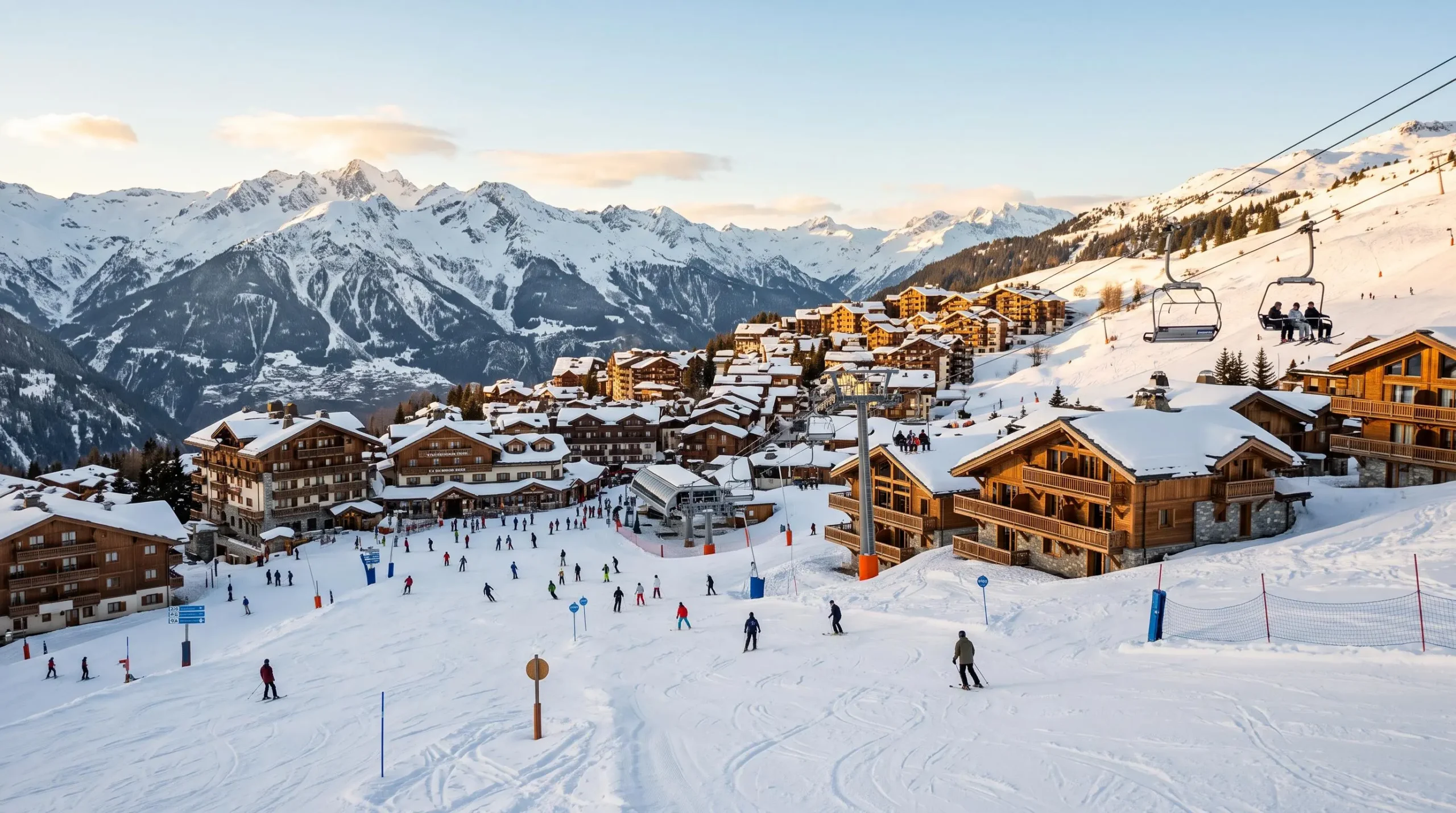
Ski-in ski-out access creates the steepest price premiums across all property types. Properties with direct piste departure command 30-50% premiums over those requiring 100-200 metre walks to lifts. Seasoned investors prioritize immediate slope access over interior specifications, recognizing that rental demand and resale liquidity correlate more strongly with ski convenience than architectural details.
The data challenges the assumption that village selection matters equally for investment versus lifestyle buyers. Pure investors focused on rental yield optimization gravitate toward Courchevel Moriond and Le Praz apartments, where lower acquisition costs per square metre and strong family-market rental demand generate superior percentage returns despite lower absolute weekly rates. Lifestyle buyers willing to accept modest rental yields or foregoing rental income entirely concentrate in Courchevel 1850 chalets, where personal usage enjoyment and long-term capital appreciation potential justify premium pricing and higher annual costs. This bifurcation means village choice reveals buyer motivation more reliably than stated investment objectives during initial property consultations.
Investment return realities beyond the rental brochure
Rental income projections cite gross weekly rates without modeling deductions that reduce headline yields by 40-60%. A worked example: a €3.1 million apartment achieving 16 weeks at €7,500 weekly generates €120,000 gross income (3.9% gross yield). Management fees (20%) deduct €24,000, vacancy periods eliminate €45,000, and annual costs total €15,000. Net income settles at €36,000—a 1.2% net yield before mortgage interest.
The rental income overestimation trap: Market listings and agency brochures cite attractive gross weekly rental rates (€7,000-15,000 per week for luxury properties) without modeling deductions. The reality for overseas owners proves significantly different: management fees consuming 20-25% of gross income, six to twelve weeks of seasonal vacancy, maintenance reserves, and property taxes collectively reduce headline 7-8% gross yields to 3-4% net returns. International buyers frequently miscalculate by focusing on gross rates published in rental comparables, then face cash flow pressure when net income falls 50% below initial projections. Model net yields with realistic 60-65% occupancy assumptions and complete cost deductions before committing investment strategy to seasonal rental dependency.
Chalets present higher gross rates offset by proportionally higher costs. A €6.2 million chalet generating €210,000 gross income (3.4% yield) faces €42,000-52,500 management fees and €60,000-80,000 running costs. Net income compresses to €75,000-110,000 (1.2-1.8% net yield)—often underperforming apartments despite doubling gross weekly rates. Chalet ownership serves lifestyle and appreciation objectives rather than income generation, while apartments optimize for cash flow efficiency.

Resale liquidity represents the final investment dimension that property type and village location influence materially. According to analysis of French property market trends published by the Notaires-INSEE quarterly index from INSEE, transaction volumes in premium alpine resorts demonstrate greater resilience during market corrections than secondary locations, with Courchevel 1850 properties maintaining liquidity even during the broader market slowdown observed in Q2 2025. Typical sale timelines range from nine to eighteen months for both chalets and apartments, though apartments in managed buildings with established rental histories sell faster than chalets requiring buyer assumption of individual service contracts and management relationships. Chalet resale value depends significantly on authentic alpine material choices and quality craftsmanship—traditional stone fireplaces and wooden stairs that define Savoyard architecture preserve investment value better than modern substitutes that dilute authentic mountain character.
Frequently asked questions: chalet versus flat ownership
Can I renovate a flat as extensively as a chalet?
French copropriété regulations governing apartment buildings distinguish between internal modifications requiring only owner decision and structural changes demanding co-owner approval through formal voting procedures. Internal renovations—kitchen replacements, bathroom updates, flooring changes, non-load-bearing wall removal—generally proceed without restriction beyond building noise regulations and working hours. Structural modifications affecting building facade, windows visible from exterior, balcony extensions, or load-bearing walls require majority approval at annual co-ownership meetings, a process taking six to twelve months. Chalets offer greater renovation autonomy since individual owners control all internal decisions, though external modifications in Courchevel's protected resort zones still require planning permission from local authorities preserving alpine architectural character. Modern luxury alpine apartments increasingly incorporate architectural features once exclusive to chalets, including interior glass roofs that dramatically enhance natural light and create striking mountain view frames—renovation possibilities in flats extend beyond cosmetic updates when building rules permit structural enhancements.
Do chalets always generate higher rental income than flats?
Chalets command higher gross weekly rental rates—€12,000-20,000 versus €5,000-10,000 for apartments during peak February season—but net rental yields often favor apartments due to lower operating cost structures and higher occupancy rates. A €6 million chalet generating €210,000 gross annual income faces €60,000-80,000 in running costs plus €42,000-52,000 management fees, producing €70,000-110,000 net income (1.2-1.8% net yield). A €3 million apartment generating €120,000 gross income incurs €15,000 running costs and €24,000 management fees, yielding €81,000 net (2.7% net yield). The apartment delivers superior percentage return despite half the gross income because operational efficiency and institutional management infrastructure reduce the deduction gap between gross receipts and net owner income. Chalet rental strategies optimize for absolute income amounts serving high-net-worth owners, while apartment investments target percentage yield efficiency.
Which property type sells faster in a market downturn?
Apartments typically attract broader buyer pools during market corrections due to lower absolute entry prices and turnkey management appeal requiring minimal operational expertise from new owners. A €3 million apartment accessible to successful professionals and dual-income households reaches perhaps ten times the buyer population of a €6 million chalet targeting ultra-high-net-worth individuals exclusively. Managed buildings with established concierge services and rental track records further accelerate apartment sales by eliminating buyer concerns about management infrastructure assembly. That said, village location influences resale speed more powerfully than property type—Courchevel 1850 chalets sell faster than La Tania apartments because prestige address and ski access trump property configuration for the international luxury buyer segment. Realistic sale timelines range nine to eighteen months for both property types in normal market conditions, extending to twenty-four months during significant corrections when financing availability contracts and currency volatility deters international buyers.
Are there restrictions on short-term rentals in Courchevel?
French meublé de tourisme regulations require property registration with local authorities when offering furnished seasonal rentals, a straightforward administrative process taking four to six weeks. Individual copropriété building rules introduce the more significant restrictions—some apartment buildings limit short-term rentals to minimum one-week stays or cap the annual rental period to prevent excessive guest turnover disrupting permanent residents. Review the règlement de copropriété (co-ownership rules) during property due diligence to identify any rental frequency restrictions before purchasing with rental income assumptions. Chalets face fewer regulatory constraints on rental activity since individual ownership eliminates co-owner approval requirements, though seasonal rental businesses generating significant income may trigger commercial activity classifications requiring business registration. Consult local property advisers regarding current Courchevel municipality policies, as French resort towns periodically debate rental restrictions similar to those implemented in Paris and other high-tourism urban centers.
How does French property tax differ for chalets versus flats?
French property taxation treats chalets and apartments identically under tax code—both incur annual taxe foncière (property tax) calculated on cadastral rental value regardless of property type, with rates determined by property location and size rather than architectural configuration. The meaningful difference emerges from property values: a €6 million chalet generates approximately €15,000-20,000 annual property tax while a €3 million apartment incurs €5,000-8,000, reflecting the value differential rather than discriminatory tax treatment. Non-resident owners face additional IFI (Impôt sur la Fortune Immobilière) wealth tax when total French real estate holdings exceed €1.3 million net value according to official French government guidance verified in March 2026. IFI applies progressive rates from 0.5% to 1.5% on the portion exceeding the threshold, affecting both property types equally based on assessed value. Rental income taxation follows identical frameworks whether generated from chalet or apartment, with non-residents subject to French income tax on rental profits after deducting allowable expenses including management fees, maintenance, and property tax itself.
The chalet-versus-flat decision ultimately resolves through honest assessment of financial capacity, usage realism, and management tolerance rather than architectural romanticism or investment mythology. Buyers who model total ten-year ownership costs, calculate net rental yields after full deductions, and match property operational demands to their available involvement capacity consistently report higher satisfaction than those seduced by gross weekly rental rates or chalet aesthetic appeal disconnected from usage patterns. The French alpine property market rewards disciplined decision frameworks that acknowledge trade-offs, while punishing aspirational purchases that ignore the €40,000 annual cost realities or the 150 hours of annual management coordination that chalets demand from overseas owners lacking local support infrastructure.
Scope and currency limitations:
- Property prices and market conditions fluctuate; data presented reflects 2026 market snapshot only and may not represent current values at time of reading
- Tax implications vary significantly based on buyer's residency status, country of origin, and bilateral tax treaty provisions—individual tax advice essential
- Individual property due diligence required for structural condition assessment, specific co-ownership rules, and planning restrictions affecting renovation potential
- Rental yield projections depend on management quality, seasonal demand fluctuations, property location within resort, and evolving short-term rental regulations
Material risks requiring professional assessment:
- Currency exchange rate fluctuations can significantly impact investment value for non-Euro buyers, affecting both property valuation and rental income when converted to home currency
- French property transaction costs including notary fees and registration taxes typically add 7-8% to purchase price as documented by official sources, requiring capital reserve beyond property price and deposit
- Rental income may prove irregular and seasonal, requiring cash reserves sufficient to cover annual running costs and mortgage payments during vacancy periods extending six to twelve weeks
- Alpine property resale timelines typically range nine to eighteen months in normal market conditions, extending significantly during corrections—liquidity assumptions must account for potential holding period extensions
Professional consultation requirements: Consult a chartered financial adviser specializing in international property investment for portfolio allocation and currency risk assessment; engage a French notaire (notary) for legal aspects of property acquisition and ownership structures; commission a certified property surveyor for technical assessment of structural condition, particularly for chalets where individual owners bear full maintenance responsibility. This guide provides decision framework orientation but cannot substitute for professional advice tailored to individual financial circumstances, tax position, and investment objectives.